Last week I gave a 20-minute talk at Internetdagarna on where I think SEO is heading. The format forced me to be specific - no hand-waving about “the future of digital” - so I committed to four concrete predictions with reasoning attached.
What follows are those four predictions, expanded from the slides with the context I did not have time to include on stage. I am writing this partly as a record I can come back to in five or ten years and grade honestly, and partly because several people in the audience asked for a written version.
Prediction 1: Content quality will eat technical tricks
This is the one I am most confident about, and the one that got the least pushback in the room.
For the past decade, the SEO industry has been built on technical manipulation of ranking signals. Link building, keyword density, schema markup, site speed optimization, crawl budget management - the toolkit has been large and increasingly sophisticated. All of it still matters, of course. But the trend line is clear: Google is getting better at evaluating content quality directly, and the relative value of pure technical manipulation is declining.
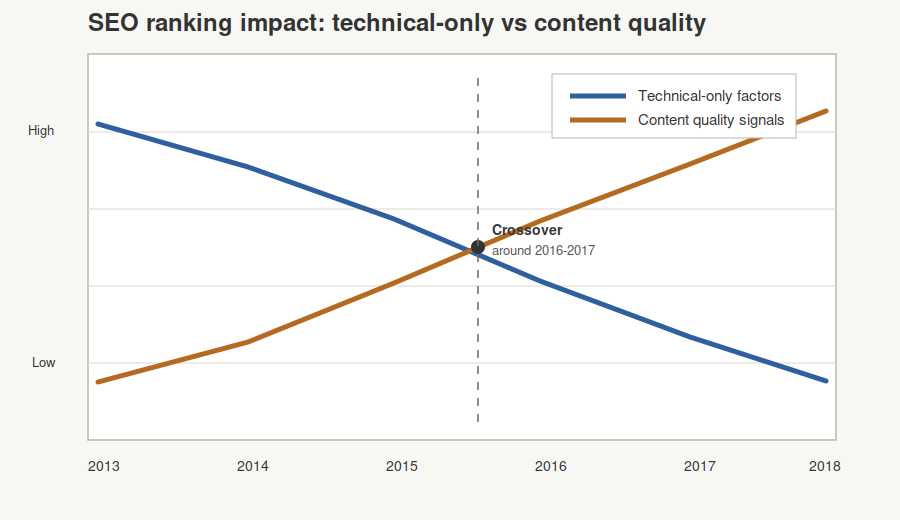
What I told the room: within three to five years, the single most important ranking factor for competitive commercial queries will be content quality - not link count, not page speed, not technical perfection. The agencies that invest in editorial capability will outperform the ones that invest only in technical capability. The winning strategy will be doing both, but if you had to choose, choose content.
The implication for our industry is uncomfortable: many SEO agencies are staffed entirely by technicians. Content strategy is either outsourced to copywriters who know nothing about search, or it is treated as a checkbox item - “we need 500 words on this landing page.” That approach is approaching its expiration date.
Prediction 2: Mobile search will eclipse desktop
The obvious one. Everyone in the room knew this was happening. What I added was the timing estimate: I believe that by 2017 or 2018, the majority of Google searches in Sweden - not globally, specifically in Sweden - will happen on mobile devices. This matters because the Swedish market tends to lag the US mobile adoption curve by 12-18 months, and the US is already close to the crossover.
The implication is not just “make your site responsive.” It is that the entire search experience changes when the primary device has a small screen, a touch interface, and a user who is often in motion. The queries change. The results page changes. The tolerance for slow loading changes. The competitive dynamics change because mobile SERPs have fewer positions above the fold.
If you are an agency that still presents SEO strategies assuming the user is sitting at a desktop with a 24-inch monitor, you are solving the wrong version of the problem.
Prediction 3: The search results page will become an answer engine
This is the prediction that generated the most discussion after the talk.
Google is already moving in this direction with featured snippets and knowledge panels. But I believe we are at the beginning of a fundamental shift: within five years, a significant share of informational queries will be answered directly on the search results page, without the user clicking through to any website.
For content publishers, this is a serious strategic problem. The traditional SEO model is: rank well → get clicks → monetize the visit. If the answer appears on the SERP itself, the ranking still happens but the click does not. Traffic drops even as visibility increases.
For commercial sites - e-commerce, SaaS, service businesses - the impact is different. These queries still require a click to convert. But the informational queries that used to drive top-of-funnel traffic to these sites will increasingly be answered by Google directly. The funnel narrows at the top.
I do not have a clean solution for this. My honest position is that it is a real problem, and the industry is not taking it seriously enough because organic traffic numbers still look healthy in aggregate. By the time the aggregate numbers show the shift, the best response options will have narrowed.
Prediction 4: Organic search traffic will grow
This is the one I am least sure about, and I said so on stage.
My reasoning: internet penetration continues to rise globally. The number of queries per user continues to rise as search becomes more habitual and as mobile makes search available in more contexts. The absolute volume of search activity is growing, and will continue to grow for at least the next five to seven years.
The counter-argument, which several people raised in the Q&A: growth in total search volume does not guarantee growth in organic traffic. If Google captures more of the answer layer (Prediction 3), and if paid results take up more SERP real estate, then organic traffic could decline even as total search volume grows.
I think the net effect is still positive - but this is the prediction I would most willingly retract if the data moves against it. The honest answer is that nobody has a reliable model for how these competing forces will net out.
What I did not predict
Someone asked me about voice search. I said I do not know enough to predict anything specific about it yet. The devices are too early. The query patterns are unclear. I would rather admit ignorance than manufacture a prediction that sounds smart in November 2015 and looks foolish by 2018.
Someone else asked about video search. Similar answer: the signal is there, but I do not have enough operational data from client work to commit to a specific prediction. I can see that YouTube results are appearing in more query types, but I cannot tell you yet whether that trend is accelerating or leveling off.
Why I made these predictions public
Partly accountability. If I am asking clients to trust our strategic recommendations, I should be willing to put my macro-level thinking on the record where it can be evaluated later. Partly because the Swedish SEO community is small enough that these conversations matter - we are all working in the same field, and sharing how we think makes the whole industry sharper.
I will revisit these predictions periodically. The honest version of expertise is not “I am always right” - it is “I state my position clearly enough that I can be corrected.”