It has been twelve months. I am writing this in mid-March 2021, almost exactly a year after the week when everything changed.
BBO is still here. We are still roughly 17 people. We are still doing the work. But the company that exists today is not the same one that existed in February 2020, and I do not mean that in the inspirational “we emerged stronger” sense that pandemic retrospectives are supposed to end with. Some of it was good. Some of it was damaging. Most of it was just difficult in ways that did not photograph well.
This is the operational diary I should have been keeping all along.
March 2020: The first two weeks
The meetings started cancelling on a Monday. By Wednesday, three clients had paused their campaigns - not cancelled, paused, which is a distinction that matters when you are trying to forecast revenue. By Friday, we had decided that everyone would work from home starting the following week.
The Gothenburg office on Stigbergsliden went quiet. I remember walking through it on the Saturday to pick up a charger and thinking that it looked like everyone had just stepped out for lunch and would be back in an hour.
The first week of remote work was dominated by three things: making sure our people were safe and set up to work from home, communicating with every active client about what was happening, and building an honest picture of our cash flow.
We started daily all-hands calls on Zoom. Not because there was always something new to report, but because silence in a crisis gets interpreted as information being withheld. The cadence mattered more than the content.
March-April 2020: Korttidspermittering
The short-time work allowance regulations appeared within days of the crisis onset. We applied early. Our reasoning was straightforward: we had experienced a demand shock, it was temporary by nature, and we had every expectation of recovery once conditions normalized. The allowance was designed for exactly this situation.
We chose our percentage levels, informed the employees, ran the employer-side processes. The financial breathing room it bought was significant - our rolling three-month cash flow view moved from red to yellow, then from yellow to cautiously near-green as some clients resumed spending over the summer.
I do not want to understate how much this mattered. Without korttidspermittering, we would have had to lay off four or five people in April 2020. With it, we kept the team intact through the worst months.
Summer 2020: Stabilization and the first strategic questions
By June, the acute phase was over for us. Most of our clients had stabilized. A few had even grown - e-commerce clients riding a COVID demand wave that put digital budgets on an accelerator.
Others were still wounded. B2B clients in sectors like travel and events had not recovered, and it was unclear when they would. We had difficult conversations about whether to continue at reduced scope or pause entirely.
The strategic question that started emerging around this time was larger: is this the right agency shape for the world that comes after? Not a crisis question - a structural one. We had been planning a specialization move before the pandemic. Now the question was whether to accelerate it, delay it, or rethink it entirely.
Autumn 2020: The BBOFRUKOST pivot
Before the pandemic, BBO had been running breakfast seminars - BBOFRUKOST - as in-person events in Gothenburg. They were a good format. Thirty to fifty people in a room, a practical talk about digital marketing, coffee and croissants. Decent lead generation.
When in-person events became impossible, we faced a choice: pause the format or move it online. We moved it online and something unexpected happened. The constraint removed a geographic ceiling. Our in-person events had been limited to people who could physically come to our Gothenburg office. The webinar had no such limit.
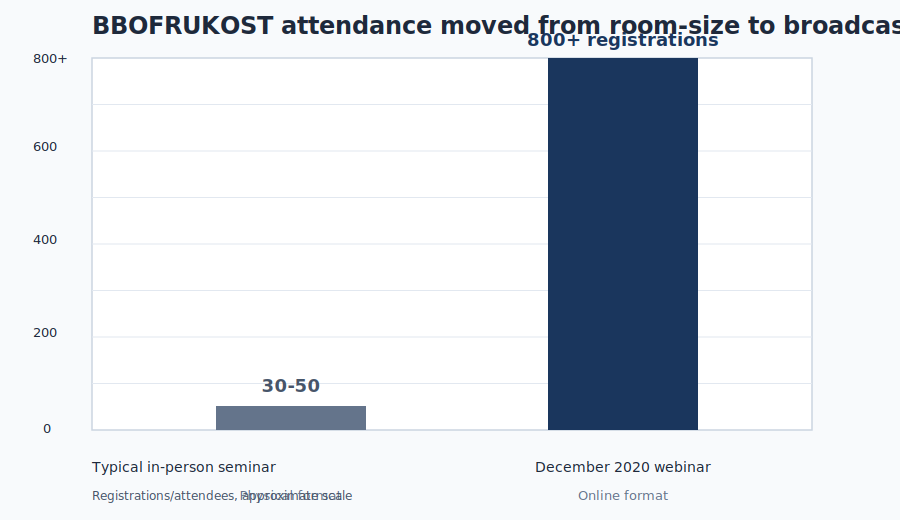
By December 2020, we ran a BBOFRUKOST webinar that drew over 800 registrations. More people signed up for a single online event than had attended all of our in-person seminars combined over the previous two years.
This was not a deliberate strategy. It was an accident born of necessity. But the implication was significant: our brand reach had been artificially limited by our physical geography. The webinar format revealed an audience that had always been there but that we had never been able to reach.
Winter 2020-2021: The Tillväxtverket review
This is the part that I find hardest to write about, because it is still ongoing.
After the initial korttidspermittering period, Tillväxtverket requires a reconciliation - an avstämning - to verify that the support was used appropriately. We filed ours as directed.
Then we waited, and waited.
What was supposed to be a standard review process stretched from weeks into months. Requests for additional documentation came in waves. We responded to each one promptly and thoroughly. We provided financial data, payroll records, client activity logs, revenue forecasts.
At one point, after months of silence, we made a decision to send a formal letter. Not hostile - factual. We explained our situation: the uncertainty was preventing us from making forward-looking staffing decisions. We could not hire because we did not know if we would owe a large repayment. We could not invest because the cash position was frozen in ambiguity. We presented a rolling nine-month forecast chart showing our revenue projections against actuals - making the trend break visible in a way that paragraphs of explanation had not achieved.
The response to the chart was faster than any previous response in the thread. I do not know whether that is because the visual made the case clearer or because the formal tone of the letter created urgency. Both, probably.
As I write this, the case is not yet resolved. We have reason to believe the outcome will be favorable, but nothing is confirmed. The uncertainty itself has been a cost - distinct from the pandemic, distinct from the financial impact, a separate tax on decision-making capacity that has lasted nearly twelve months.
What I have learned that does not fit in any single section
Communication cadence matters more in a crisis than communication content. Daily updates during the acute phase, weekly during stabilization, then back to the normal monthly rhythm. But do not downshift too early. Teams perceive a sudden drop in communication frequency as a signal that information is being withheld.
Forecast discipline earns its value before the crisis. Our rolling nine-month forecast existed because we had been doing it for years as standard practice. It was not something we built during the pandemic. When we needed to show Tillväxtverket a visual trajectory of what the crisis did to our revenue, the data was already there. If you do not have a rolling forecast, the time to build one is before you need it.
Geography is a ceiling you stop noticing. The webinar pivot taught me that our market was not Gothenburg, or even Sweden. It was anyone who cared about digital marketing and could understand Swedish or English. We had been building a local business in a market that was already global.
Government aid is not neutral. The korttidspermittering was a lifeline. I am genuinely grateful it existed. But the review process itself created a separate category of damage - frozen hiring, deferred investment, months of planning paralysis. Aid that arrives with twelve months of uncertainty attached is a different thing than aid that arrives cleanly. Both things can be true.
What I do not know yet
Whether Tillväxtverket will ultimately decide in our favor. Whether our specialization thesis is right. Whether the post-pandemic agency shape is broadly similar to what existed before or something materially different. Whether another crisis window is coming.
This diary covers twelve months. The story is not over. Some of what feels clear to me right now will turn out to be wrong - an artifact of the moment rather than a durable insight. The discipline is to write it down honestly so that the reconstruction later has something real to build on.