Last September, Google killed my AdSense account. No warning shot, no escalation path, no human being to call. Just a message in the dashboard: account disabled, balance forfeited, decision final.
Behind that account sat more than 200 websites I had built over several years. Every single one of them depended on AdSense for revenue. In one automated decision, my entire income went to zero.
I have been sitting with this for nearly a year now. Long enough to rebuild. Long enough to understand what actually went wrong - and it was not Google.
How I got there
I have been building websites since I was twelve. Not as a hobby - as a business. Three e-commerce stores, a sprawling network of niche sites, affiliate portals, comparison engines, travel directories. By 2008, the portfolio had grown past 200 properties, and they were making real money through Google AdSense.
The strategy felt smart: go wide across dozens of niches, watch what gains traction, double down on the winners. Many sites, many topics, many traffic sources. Looks like diversification on paper. Feels like diversification when the checks come in.
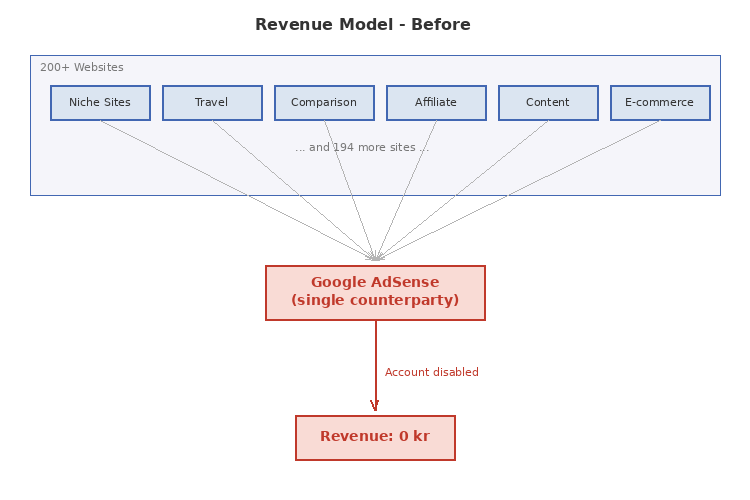
What I missed entirely was this: I had diversified traffic without diversifying revenue. Nearly every site in the portfolio earned through a single channel - Google AdSense. Two hundred sites, one counterparty. One switch that could turn all of it off.
For three years, nobody flipped that switch. Then somebody did.
The ban
The notification was boilerplate. “Invalid click activity.” That phrase covers everything from fraud (never) to a competitor sabotaging your account by clicking your ads repeatedly (entirely plausible when you rank well in competitive niches across 200+ domains). No specifics, no evidence, no conversation.
I appealed immediately. The outstanding balance alone justified the effort, never mind the years of work behind it. Google’s response was another automated message: decision reviewed, decision upheld. No reasoning. No contact person. No follow-up questions accepted.
I spent days trying to find a real human at Google who handled publisher disputes. There is no such person. The AdSense program is designed so that communication runs one direction - from Google to you. You read, you accept, you move on. Or you do not move on, but it changes nothing.
The money sitting in the account? Gone.
What I actually built
Looking back with clear eyes, the picture is embarrassing in its simplicity. I had convinced myself I was running a diversified portfolio. Two hundred sites. Dozens of niches. Traffic from organic search, paid ads, referrals, social media.
But strip away the complexity and the business model was: build pages → get traffic → show Google ads → collect Google checks. One company controlled the only part that generated cash. They could end the relationship at any time, for any reason, with no obligation to explain or compensate. This is what vendor lock-in looks like when you do not see it coming.
That is exactly what happened.
This is not really an unfair arrangement. Google has millions of publishers. Losing one does not register. I had one ad revenue provider. Losing them was existential. The power imbalance was baked in from the start. I just never looked at it squarely until I had to.
The part that stings
Months before the ban, I actually wrote about being nervous that Google could shut down my account without warning. I noted that affiliate programs were safer because “there is a larger selection of players” and if one network cuts you off, you switch to a competitor. I had the diagnosis. I had it in writing. I just did not act on it fast enough, because the revenue was too good and the risk felt theoretical.
That is the trap. When something works, you pour more into it. Every new site I launched went straight onto AdSense because that was the proven model. The machine that was making money was the same machine making me more dependent. I knew it and I kept feeding it anyway.
Rebuilding differently
The last several months have been about undoing that dependency at every level.
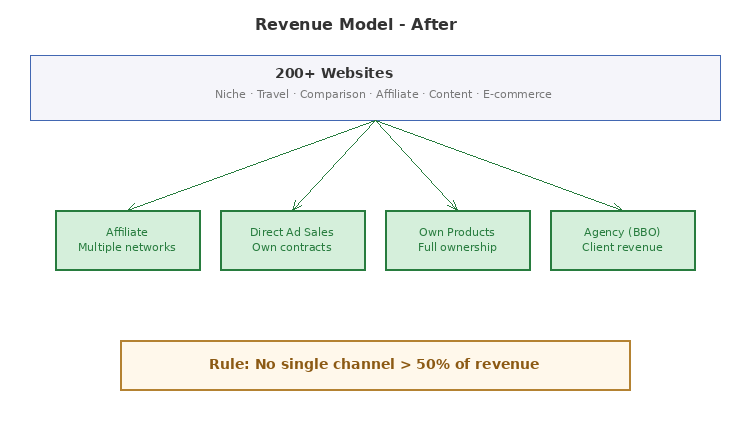
Be Better Online. I launched an SEO agency in August, right before the ban. What started as a side venture became the main business overnight. An agency sells expertise directly to clients. No intermediary platform sits between us and the revenue. The client chooses to stay or leave - that is healthy symmetry, not one-sided control.
Multi-network monetization. Every surviving site now runs revenue from at least two independent sources. Affiliate programs across several networks, not just TradeDoubler. Direct ad sales where the traffic justifies it. Proprietary products on the highest-traffic properties. If any single partner disappears, the site keeps earning.
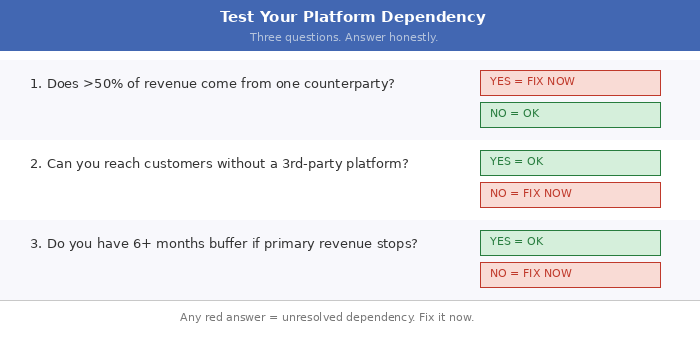
The counterparty rule. I now operate on a simple principle: if more than half the revenue from any project flows through a single counterparty, that is an unresolved dependency. Not a concern to monitor - a problem to fix. Not next quarter. Now.
The general lesson
This is bigger than AdSense. It is the same pattern everywhere someone builds a business on top of a platform they do not control.
I have talked to people in this industry over the past few months, and the stories are identical in structure. Affiliates with everything running through one network. E-commerce operators spending their entire ad budget on one channel. Content sites that live and die by one traffic source.
Everyone says the same thing: it has worked well so far. That is the whole problem, of course.
AdSense, TradeDoubler, eBay Partner Network - the specific platform does not matter. The diagnostic question is always the same: if this counterparty shuts you down tomorrow, what happens to your revenue? If the honest answer is “it goes to zero,” then you have a single point of failure dressed up as a business, and you need to fix it before the decision is made for you.
Two things I wish I had done
First: build an email list from day one. Not for marketing fluff - for survival. An email list is the only audience channel where no third party holds the kill switch. You own the list, you own the relationship, and you need nobody’s permission to reach your readers. I had 200 sites and zero direct relationships with the people visiting them. Some of my sites had thousands of daily visitors - people who came back repeatedly - and I had no way to reach a single one of them once Google cut the cord. That was inexcusable.
Second: keep two years of operating costs in a dedicated reserve, earmarked specifically for the scenario where your primary revenue source vanishes. Not a general savings cushion - a survival fund for exactly this type of event. If I had built that buffer, September would have been stressful instead of catastrophic.
Where things stand
Be Better Online is growing fast. Good clients, a team coming together, and a business model where no single company can pull the plug on us. The most important thing I took from losing 200 sites overnight is a rule I repeat to myself constantly: never, ever build a business that depends on one player’s continued goodwill.
It sounds like something everyone already knows. It is not. I had 200 sites and genuinely believed I was diversified. I was not.
If you have been through something similar, I would like to hear about it. Drop me an email or leave a comment.